In the annals of American political history, few chapters will be studied as intensely as the political resurrection of Donald Trump. From the chants of “Fight, Fight, Fight” following an assassination attempt to a landslide re-election that defied the polls, Trump’s return to the White House is not just a change in administration—it is a paradigm shift.
For the rest of the world, the first 100 days of Trump’s second term have been a crash course in “America First” governance. The dismantling of USAID and the retreat from multilateral institutions signal a United States that is no longer interested in being the world’s policeman. Instead, we have entered an era of purely transactional diplomacy.
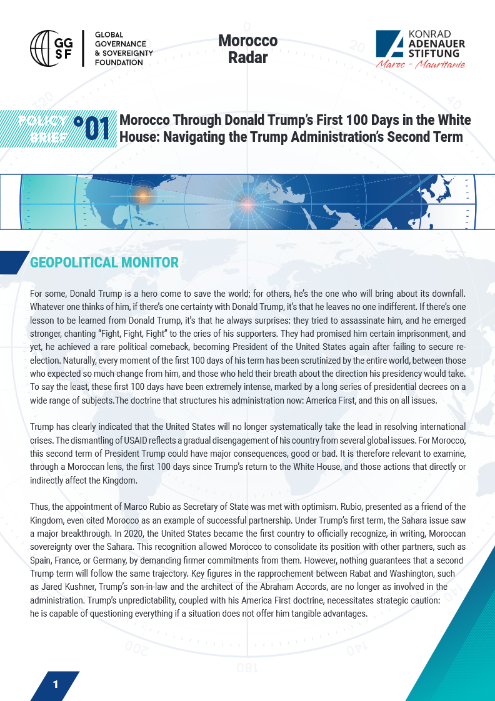
For the Kingdom of Morocco, this new reality presents a complex matrix of high-risk challenges and high-reward opportunities. As detailed in our latest Policy Brief, “Morocco Through Donald Trump’s First 100 Days,” the second Trump term could either catapult Rabat’s strategic standing to new heights or place it in the crosshairs of a global trade war.
Here are the key takeaways from our analysis of how the Kingdom can navigate this volatile new world order.
The Diplomatic Signals: Rubio, Buchan, and the Sahara
The personnel choices of the incoming administration offer the first and most potent signals for Rabat. The optimism in Moroccan diplomatic circles is well-founded, particularly regarding the appointment of Marco Rubio as Secretary of State. A long-time friend of the Kingdom, Rubio has frequently cited Morocco as a model of successful partnership.
Even more significant is the appointment of Duke Buchan III as the US Ambassador to Morocco. Buchan is not merely a diplomat; he is a Trump loyalist with a direct line to the Oval Office and extensive experience as the former Ambassador to Spain. His deep understanding of the Iberian Peninsula and security issues suggests a strategic intent to leverage the Rabat-Madrid axis to secure American interests in the Mediterranean and the Atlantic.
The Strategic Opportunity:
The Policy Brief highlights a major potential breakthrough: the consolidation of the 2020 recognition of Moroccan sovereignty over the Sahara. With the Trump administration favoring bilateral deals over UN processes (and skeptical of the cost of missions like MINURSO), there is a growing push within US policy circles to designate the Polisario Front as a Foreign Terrorist Organization (FTO). Backed by figures like Congressman Joe Wilson and the Hudson Institute, this move would be justified by the Polisario’s alleged ties to Iran’s IRGC—an entity the Trump administration remains aggressively hostile toward.
The Economic Tightrope: Tariffs and the “China Factor”
While the diplomatic front looks promising, the economic landscape is fraught with “points of vigilance.” True to his “dealmaker” persona, President Trump has upended global trade with a universal 10% tariff on all imports. Despite Morocco’s 2006 Free Trade Agreement with the US, the Kingdom has not been spared.
However, our analysis reveals a counter-intuitive silver lining. While a 10% tariff is a burden, Morocco retains a competitive advantage compared to its neighbors and competitors.
- European Union: Hit with a 20% tariff.
- Tunisia: Facing a 28% tariff.
This differential makes Morocco a relatively more attractive destination for European firms looking to relocate production to bypass higher taxes, particularly in textiles and agribusiness.
The Red Line:
The most critical risk identified in the brief involves the geopolitical tug-of-war over Chinese investment. Morocco has successfully courted Chinese capital to build a hub for electric vehicle (EV) batteries, exemplified by the massive $1.3 billion Gotion gigafactory in Kenitra.
In a Trump administration that has slapped tariffs of up to 145% on Chinese goods, these investments are a flashpoint. If Washington perceives these projects as a “Trojan Horse” for Beijing’s economic influence, Morocco could face secondary sanctions. Rabat must tread a fine line: welcoming foreign direct investment while ensuring it does not cross the red lines of its most important strategic ally.
Security & The Sahel: Filling the Void
The geopolitical vacuum left by the US withdrawal from Niger in September 2024 has created a security crisis in the Sahel—and a distinct opportunity for Morocco.
The Trump administration’s aversion to “endless wars” means the US is looking for capable regional partners to shoulder the burden of security. Morocco is perfectly positioned to fill this role. The Royal Armed Forces (FAR) are undergoing a significant modernization, solidified by the acquisition of Stinger surface-to-air missiles in March 2025, alongside F-16s and Apache helicopters.
Morocco is the only regional actor capable of maintaining dialogue with the Alliance of Sahel States (AES) while remaining a staunch US ally. By positioning itself as a stabilizer and a mediator, Morocco can offer Washington a “victory” in counterterrorism without requiring American boots on the ground. This alignment cements Morocco not just as a participant in the “African Lion” military exercises, but as the indispensable security hub of North Africa.
Foresight: The Era of “Agile Diplomacy”
The days of relying on traditional multilateral frameworks are fading. The UN Security Council’s influence is waning under the weight of great power rivalry. In this fragmented landscape, Morocco’s strength lies in its “Agile Diplomacy.”
The Kingdom must act as a connector—balancing its deep security ties with the US, its economic integration with the EU, and its partnerships with the Global South. The risks of Trump’s unpredictability are real; the absence of former architects like Jared Kushner means Rabat cannot rest on past laurels. However, if Morocco can navigate the economic minefield of US-China rivalry, the second Trump term offers a rare window to permanently resolve the Sahara issue and emerge as a mid-sized global power.
📥 Read the Full Analysis
To understand the granular details of the trade implications, the path to the FTO designation for the Polisario, and the strategic foresight required for 2025 and beyond, we invite you to read the full document.
[Read Policy Brief No. 01: Morocco Through Donald Trump’s First 100 Days]