The Strategic Shift: High-Tech Sovereignty
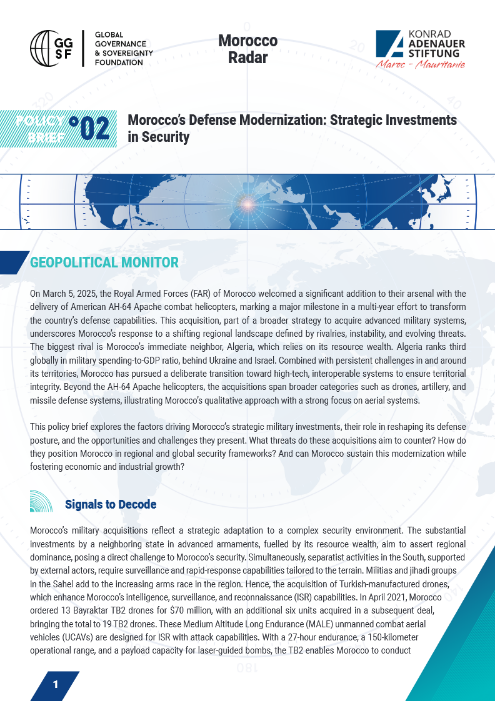
On March 5, 2025, the geopolitical landscape of North Africa shifted perceptibly as the Royal Armed Forces (FAR) took delivery of American AH-64 Apache combat helicopters. This delivery was not merely a procurement milestone; it was a signal of Morocco’s decisive transition toward a high-tech, interoperable defense posture designed to safeguard its territorial integrity in an increasingly volatile region.
According to Policy Brief No. 02 released by the GGSF, this modernization is a calculated response to a “shifting regional landscape defined by rivalries, instability, and evolving threats.” The stakes are high. Morocco’s immediate neighbor, Algeria, now ranks third globally in military spending-to-GDP ratio—trailing only Ukraine and Israel—creating a pressure cooker of regional militarization. Combined with the withdrawal of traditional powers like France and the U.S. from parts of the Sahel, Morocco is stepping forward not just to defend its borders, but to anchor regional security.
Signals to Decode: The Geometry of Deterrence
The GGSF analysis reveals that Morocco is moving beyond simple hardware accumulation toward a doctrine of “qualitative superiority” and industrial integration. The brief highlights several critical data points that investors and defense analysts must decode:
- The Drone Revolution: Morocco is betting heavily on Unmanned Combat Aerial Vehicles (UCAVs). Following an initial $70 million deal in April 2021 for 13 Bayraktar TB2 drones, the fleet has expanded to 19 units. However, the game-changer is the Bayraktar Akinci, a heavier platform with a 7,500-kilometer range and 40-hour endurance, capable of deep-strike missions and electronic warfare.
- Industrial Sovereignty: In a move to reduce reliance on foreign supply chains, Turkish manufacturer Baykar announced in early 2025 a new facility in Morocco. This plant aims to serve the country’s growing fleet, with a potential production capacity of up to 1,000 drones annually, marking a massive leap toward industrial autonomy.
- Air & Land Dominance: The brief confirms the scheduled delivery of F-16 Block 70/72 aircraft in 2027. These jets feature APG-83 AESA radar, extending combat radius beyond 550 kilometers. On the ground, the FAR is enhancing precision with the Atmos 2000 (a 155mm howitzer with a 41km range) and the M142 HIMARS systems approved in a 2023 deal worth $750 million.
- The Financial Commitment: Sovereignty comes at a price. In 2024, Morocco allocated $5.5 billion to defense expenditures—3.5% of its GDP—representing a 2.6% increase from the previous year.
Strategic Positioning: A Pivot to the Atlantic and Sahel
Does Morocco have a role to play beyond self-defense? The Policy Brief argues yes. As political upheavals fracture the Sahel, Morocco is positioning itself as a “stabilizing force.”
The Kingdom’s diplomatic neutrality allows it to act as a bridge between West African and Sahelian states. Militarily, the announcement of a new aerial base in the southern region in early 2025 signals a capability to project power deep into the Sahel to disrupt insurgent supply lines.
Furthermore, Morocco is cementing its status as the transatlantic gateway to Africa. Through the African Lion exercises—hosted since 2007 and involving over 7,000 participants—Morocco demonstrates its interoperability with NATO and U.S. systems. This synergy is crucial following the U.S. withdrawal from Niger in 2024; Washington increasingly views Rabat as a reliable partner for burden-sharing in counterterrorism operations.
Analysis: Opportunities vs. Vigilance
The GGSF brief outlines a dual-track assessment of this modernization drive:
Opportunities:
- Territorial Integrity: Advanced ISR (Intelligence, Surveillance, and Reconnaissance) capabilities provide persistent monitoring over the vast desert regions, allowing the FAR to neutralize separatist threats with unprecedented precision.
- Industrial Integration: Morocco is entering the global supply chain. The Kingdom has been integrated into Lockheed Martin’s global F-16 production chain, leveraging industrial hubs like Nouaceur to produce components, thereby fostering a domestic defense ecosystem.
Points of Vigilance:
- Regional Escalation: There is a tangible risk of being drawn into a “destabilizing cycle of military one-upmanship.” The brief advises focusing on defensive systems (like the Patriot PAC-3) to avoid a costly arms race that could strain economic development.
- Industrial Barriers: Despite the drone factory announcement, the brief notes a “gap in advanced manufacturing capabilities and skilled labor” required for complex systems like the Caesar artillery or Patriot missiles.
Foresight: The Next Decade of Defense
Looking ahead, GGSF analysts identify two critical gaps that will define the next phase of Morocco’s strategic evolution: Naval Power and Cyber Warfare.
While land and air domains have secured the lion’s share of investment, the brief warns that naval capabilities “lag behind.” To secure its 3,500-kilometer coastline and Exclusive Economic Zone (EEZ), Morocco must pivot toward acquiring multi-purpose frigates with anti-submarine capabilities. Protecting underwater infrastructure—specifically sovereign internet cables—is now a matter of national security.
Simultaneously, the rise of hybrid threats necessitates the creation of a dedicated Cyber Command. By collaborating with NATO, Morocco aims to protect its digital borders against disinformation and infrastructure attacks, completing its transformation into a versatile, multi-domain power.
Dive deeper into the strategic details.
Understand the full scope of the technological specs, the financial breakdown, and the geopolitical forecast.