The Strategic Shift: Beyond Security to Connectivity
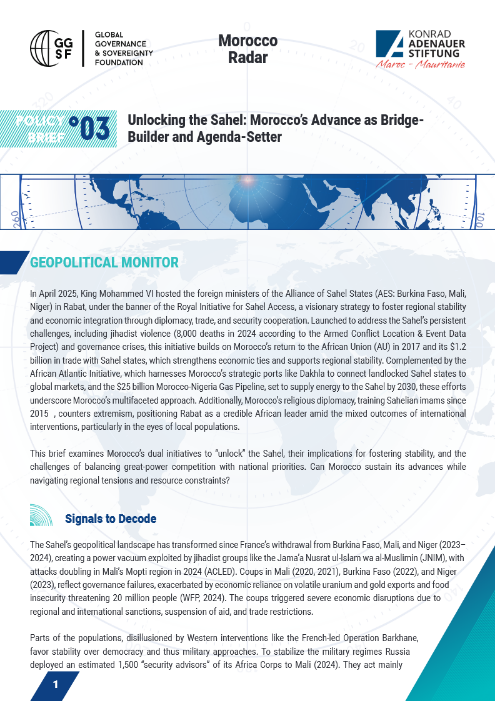
The geopolitical map of West Africa is being redrawn, and Rabat is holding the pen. Following the April 2025 summit hosted by King Mohammed VI with the foreign ministers of the Alliance of Sahel States (AES)—Burkina Faso, Mali, and Niger—Morocco has formally operationalized a pivot that transcends traditional diplomacy. This is no longer just about counter-terrorism; it is about providing a lifeline to the landlocked.
As detailed in GGSF Policy Brief No. 03, the Royal Initiative for Sahel Access represents a visionary strategy to integrate the Sahel into the Atlantic economy. With the withdrawal of Western powers and the fracturing of traditional alliances, Morocco is stepping into the void not with boots on the ground, but with trade corridors, energy infrastructure, and religious diplomacy.
For global investors and policymakers, the question is no longer whether Morocco has Sahelian ambitions, but whether it can sustain its role as the region’s primary bridge-builder amidst intensifying great-power competition.
Signals to Decode: The Vacuum and the Value
To understand the urgency of Morocco’s initiative, one must analyze the data emerging from the Sahel’s transformation between 2023 and 2025. The vacuum left by the withdrawal of French forces (Operation Barkhane) created a volatile landscape.
According to the analysis in our latest brief, several critical signals define the current reality:
- Escalating Violence: The security vacuum has been exploited by groups like JNIM, with conflict-related deaths reaching 8,000 in 2024 alone.
- The Russian Factor: Filling the security gap, Russia’s “Africa Corps” has deployed an estimated 1,500 security advisors to Mali as of 2024, securing resource concessions in gold and uranium.
- Economic Fragility: Governance failures and sanctions have exacerbated food insecurity, now threatening 20 million people across the region.
However, amidst this instability, Morocco has carved out a zone of economic resilience. Moroccan exports to Africa have surged from 300 million in 2004 to 3 billion in 2024**. Furthermore, trade with Sahel states specifically has reached $1.2 billion, proving that economic integration can thrive even in a high-risk environment.
Strategic Positioning: The “Sole Corridor”
Morocco is positioning itself as the indispensable logistical hub for the Sahel. The Brief highlights a critical development in aviation: following the withdrawal of Air France and the closure of Malian airspace to Algeria, Royal Air Maroc (RAM) has become the primary link between Bamako and Europe, operating twice-daily flights. While competitors like Turkish Airlines face economically unprofitable detours, Morocco’s geographic and diplomatic positioning has made it the sole viable corridor for the Sahel’s connectivity.
This air dominance is complemented by the Royal Initiative for Sahel Access, launched in November 2023. By granting Sahel states access to Moroccan ports—specifically the $1.2 billion Dakhla Atlantic port set for completion in 2029—Rabat is offering a tangible alternative to the unstable routes of the past.
Opportunities & Risks
The GGSF analysis identifies a “hybrid strategy” where Morocco balances bilateral ties with broad regional frameworks. Here is the balance sheet for the Kingdom:
Opportunities
- Energy Integration: The $25 billion Morocco-Nigeria Gas Pipeline (AAGP) is the cornerstone of this vision. Designed to deliver 15-30 billion cubic meters of gas annually, it promises to address the energy deficit in the Sahel, where 70% of the population lacks reliable electricity.
- Diplomatic Soft Power: Through the training of Sahelian imams (ongoing since 2015) and its neutrality in the ECOWAS-AES tensions, Morocco has retained credibility with military regimes that are otherwise hostile to foreign intervention.
Points of Vigilance
- Financing the Ambition: The AAGP requires massive capital mobilization across 13 countries. While the UAE has contributed, reliance on external funding risks diluting the “African-led” nature of the project.
- Security of Infrastructure: Commercial corridors are only as useful as they are safe. With jihadist attacks rising by 20% in 2024, securing a 6,000-kilometer pipeline and road networks against insurgent disruption remains a formidable logistical and financial challenge.
- Geopolitical Entanglement: While Morocco seeks neutrality, the region is a chessboard. Russia’s transactional model (security for resources) offers immediate gains to Sahelian juntas, potentially overshadowing Morocco’s long-term developmental approach.
Foresight: The Mauritanian Pivot
Looking toward 2030, our analysts argue that Mauritania will be the linchpin of Morocco’s Atlantic strategy. As the geographic bridge between North Africa and the Sahel, Mauritania’s ports (Nouakchott and Nouadhibou) handled over 5.2 million tons of cargo in 2022 and are vital trade arteries.
What to Watch:
- 2029 Milestone: The first section of the Afro-Atlantic Gas Pipeline is projected to be operational by 2029.
- Diplomatic Balancing: Watch for how Nouakchott navigates the rivalry between Morocco and Algeria. A realignment of Mauritania toward Morocco’s Atlantic initiative would cement the Kingdom’s role as the agenda-setter for West Africa.