The Strategic Pivot: From Alliances to Integration
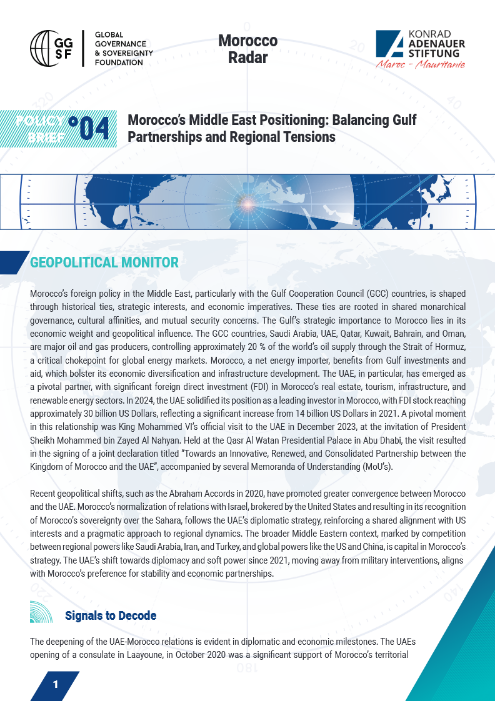
Morocco’s foreign policy is undergoing a structural transformation, shifting from traditional diplomatic alignment to deep economic and security integration with the Gulf Cooperation Council (GCC). As detailed in GGSF Policy Brief No. 04, this is not merely a search for capital; it is a recalibration of Morocco’s status as a “Middle Power” within the MENA region.
The gravitational center of this shift is the United Arab Emirates. Following King Mohammed VI’s pivotal visit to Abu Dhabi in December 2023, the partnership has evolved into a comprehensive strategic alliance. For global investors and defense analysts, the stakes are high: Morocco is leveraging Gulf weight to diversify its economy beyond European dependence while fortifying its security architecture against regional threats.
Signals to Decode: The $30 Billion Surge
The metrics of this partnership reveal a dramatic acceleration in economic interdependence. Our analysis in Policy Brief No. 04 highlights critical data points that define this new era:
- FDI Explosion: The UAE has solidified its position as a leading investor in the Kingdom. Foreign Direct Investment (FDI) stock surged from 14 billion in 2021 to approximately 30 billion in 2024.
- Infrastructure & Energy: A consortium involving the Mohammed VI Investment Fund and the UAE’s TAQA signed a deal in May 2025 valued at $2 billion. This project focuses on water security, including the construction of four desalination plants in Tangier, Nador, Tiznit, and Tan-Tan.
- Defense Transfers: The security dimension is equally robust. Discussions are underway for the transfer of 30 Mirage 2000-9E fighter jets to the Royal Moroccan Air Force by 2027. This complements the $1 billion US arms sale approved in December 2020, which included HIMARS rocket systems and Apache helicopters.
- Trade Balance: While the EU remains Morocco’s primary trading partner with $60 billion in trade in 2024, the Gulf partnership offers a “counter-model” focused on rapid, flexible development financing without the regulatory conditionality often attached to Western funds.
Strategic Positioning: The “Middle Power” Doctrine
Does Morocco have a role to play in the complex security architecture of the Gulf? The Brief applies the Regional Security Complex Theory (RSCT) to argue that Morocco has successfully carved out a niche as a “Middle Power”—an actor with advantageous geography and diplomatic agility.
Morocco serves as the “Gateway to Africa” for Gulf ambitions. With the UAE investing $59.4 billion in Africa over the past decade, Morocco acts as the logistical and financial conduit for these funds, particularly toward West Africa. Conversely, Morocco maintains a stance of strategic neutrality in intra-GCC disputes, a policy that preserved its credibility during the 2017 Qatar blockade. This balancing act allows Rabat to secure diverse funding—from the UAE’s sovereign wealth funds to Qatar’s FDI—while positioning itself as a stable mediator in a volatile region.
Opportunities & Risks
The strategic alignment with the Gulf offers high rewards but introduces complex vulnerabilities.
Opportunities
- Renewable Energy Hub: Investments like the Noor Solar Power Complex and the new desalination projects support Morocco’s goal of achieving 52% renewable energy capacity by 2030.
- Economic Diversification: The partnership reduces reliance on agriculture and phosphates. The UAE’s Etisalat now holds a majority stake in Maroc Telecom, and the potential UAE investment in the $25 billion Nigeria-Morocco Gas Pipeline could accelerate Morocco’s emergence as an energy transit hub.
Points of Vigilance
- The Iranian Threat: Alignment with the Gulf places Morocco firmly in the anti-Iran coalition. Reports from 2024 indicate Iran is utilizing asymmetric strategies, including training Polisario Front fighters via Syrian intermediaries, to threaten Morocco’s territorial integrity.
- Oil Price Volatility: Morocco’s economic plans are now partially tethered to the price of a barrel. A decline in global oil prices could shrink Gulf investment capacity, as seen during the 2014-2016 slump when GCC inflows dropped by 12%.
- Regional Backlash: Deepening ties with Saudi Arabia and the UAE risks alienating non-aligned African states. Rivals like Algeria may exploit this to portray Morocco as prioritizing Gulf interests over African solidarity.
Foresight: The Syrian Variable
Looking ahead, GGSF analysts identify a “plausible scenario” that could reshape the region’s geopolitical map. Following a hypothetical political transition in Syria and the apparent rapprochement between a new Syrian government and Saudi Arabia, Morocco may pivot its stance on Damascus.
Currently, relations are strained due to Syria’s role in facilitating Iranian support for the Polisario. However, if Iranian influence in the Levant wanes, Morocco could transform this hostility into a strategic partnership. This potential realignment highlights Morocco’s pragmatic capacity to navigate the shifting sands of the MENA region, potentially turning a former adversary into a partner in the new multipolar landscape.