The “Sputnik Moment” for Moroccan Defense
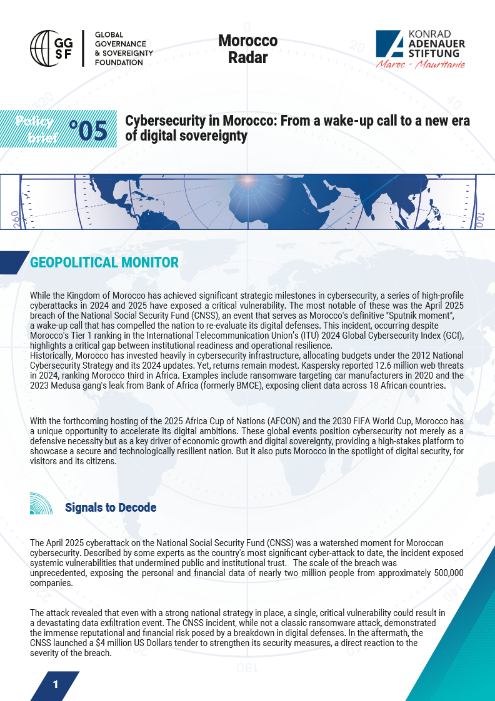
In the digital age, a breach of data is a breach of sovereignty. The April 2025 cyberattack on the National Social Security Fund (CNSS) was not merely a technical failure; it was, as described in GGSF Policy Brief No. 05, Morocco’s definitive “Sputnik moment.” This watershed event shattered the illusion of invulnerability and exposed a critical gap: while the Kingdom holds a Tier 1 ranking in the ITU’s Global Cybersecurity Index, its operational reality is dangerously exposed.
With Morocco preparing to host the 2025 Africa Cup of Nations (AFCON) and the 2030 FIFA World Cup, the stakes have shifted. Cybersecurity is no longer an IT function; it is the frontline of national defense and economic credibility. The question facing Rabat is clear: Can the Kingdom close the gap between its high-level strategy and the fragile reality of its private sector before the world arrives at its doorstep?
Signals to Decode: The Cost of Complacency
The metrics analyzed in our latest brief paint a stark picture of the threat landscape between 2024 and 2025. The CNSS breach was unprecedented in scale, exposing the personal and financial data of nearly two million people and approximately 500,000 companies.
Key data points from the brief highlight the severity of the situation:
- The Threat Volume: In 2024 alone, Kaspersky reported 12.6 million web threats targeting the Kingdom, ranking Morocco third in Africa for cyber vulnerability.
- The Financial Response: In the immediate aftermath of the attack, the CNSS launched a $4 million (USD) tender to fortify its defenses—a reactive cost that underscores the price of delayed resilience.
- The Corporate Blind Spot: A SecureWeb report cited in the brief reveals a pervasive “culture of apathy”: 53% of Moroccan businesses openly state they “do not care about cybersecurity” even after being warned of vulnerabilities, and 78% only adopt a strategy after a hack has occurred.
Strategic Positioning: The Militarization of Cyber Defense
Morocco is responding by elevating cybersecurity from a technical administration to a national security imperative. The institutional anchor of this shift is the General Directorate of Information Systems Security (DGSSI).
The brief highlights a powerful signal of this strategic pivot: the appointment of Brigadier General Abdellah Boutrig as Director General by King Mohammed VI. By placing a senior military official at the helm and keeping the DGSSI under the National Defense Administration, Morocco is explicitly acknowledging that cyber threats are now martial threats.
Functionally, maCERT (Moroccan Computer Emergency Response Team) serves as the operational hub, but its effectiveness relies on a decentralized ecosystem that is currently failing to report and respond. The strategy is sound, but the execution requires a cultural shift across the entire nation.
Opportunities & Risks
The path forward requires balancing defensive rigor with economic innovation.
Opportunities
- Homegrown Sovereignty: The crisis has catalyzed a burgeoning startup ecosystem. Nucleon Security, a Moroccan firm, recently raised 3 million Euros and partnered with Orange Morocco, demonstrating that digital sovereignty can drive economic value.
- Diplomatic Leverage: Morocco is embedding cybersecurity into its foreign policy. Key agreements include an MoU with the United States (October 2023) involving the Department of Homeland Security, and similar defense pacts with India (September 2025) and the UAE. These partnerships are essential for sharing threat intelligence on transnational ransomware.
Points of Vigilance
- The “Weakest Link” Syndrome: Despite high-level policy, 40% of businesses still rely on a single IT staff member for all security issues. This lack of depth makes the private sector a fragile attack surface.
- High-Stakes Exposure: Hosting AFCON and the World Cup makes Morocco a prime target for geopolitical rivals and financial cybercriminals. A successful attack during these events would cause reputational damage far exceeding the cost of the CNSS breach.
- Legacy Vulnerabilities: The persistence of outdated software and the “human factor”—susceptibility to social engineering—remain the most significant entry points for attackers.
Foresight: The “Carrot and Stick” Era
Looking ahead, GGSF analysts predict the end of voluntary compliance. The disconnect between national strategy and corporate negligence has become untenable.
What to Watch:
- Mandatory Enforcement: Expect the DGSSI to gain “legal teeth.” The future model will likely institutionalize a “carrot and stick” approach, where failure to conduct cyber audits or report incidents will result in severe sanctions.
- Regulatory Aggression: The National Control Commission for the Protection of Personal Data (CNDP) is already shifting gears, ready to impose fines ranging from 1,000 to 20,000 Euros and potential imprisonment for negligence.
- Standardization: DGSSI certification is expected to become a prerequisite for both public and private entities, forcing a standardized level of security maturity across the economy.