Beyond the Pitch: The Geopolitics of Victory
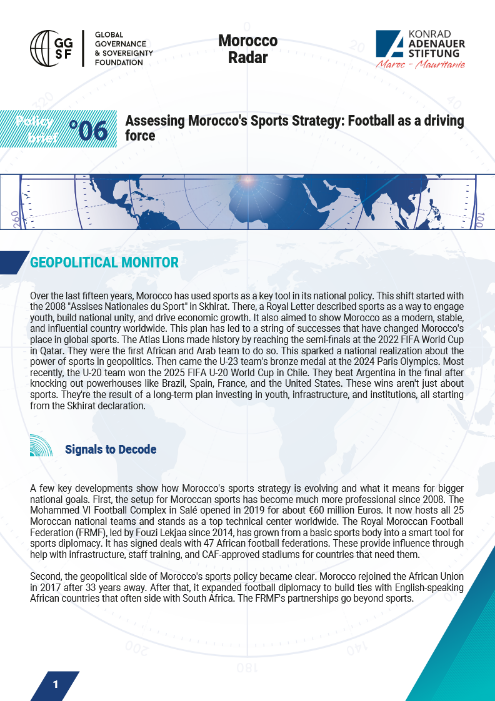
In the high-stakes arena of international diplomacy, Morocco has deployed an unconventional yet highly effective asset: its national football team. The historic victory of the U-20 team at the 2025 FIFA U-20 World Cup in Chile—where the Atlas Cubs defeated Argentina in the final after dispatching powerhouses like Brazil, Spain, and France—is not a fluke. It is the calculated result of a fifteen-year state strategy initiated by the 2008 “Assises Nationales du Sport” in Skhirat.
As detailed in GGSF Policy Brief No. 06, Morocco has elevated sports from a recreational pastime to a pillar of national policy. This strategy, ratified by the highest levels of the state, utilizes success on the field to secure influence in the African Union, drive tourism revenue, and project an image of modernity and stability. For observers of North African geopolitics, the message is clear: Rabat is not just playing games; it is building a soft power juggernaut.
Signals to Decode: The ROI of “Stadium Diplomacy”
The brief analyzes the dividends of this long-term investment. The turning point was not merely the 2022 World Cup semi-final run in Qatar, but the institutionalization of success that followed.
Key data points from the analysis include:
- Diplomatic Reach: The Royal Moroccan Football Federation (FRMF), led by Fouzi Lekjaa, has signed partnership agreements with 47 African football federations. These deals involve infrastructure support and training, effectively countering rivals like South Africa by building alliances with English-speaking African nations.
- Infrastructure Investment: The Mohammed VI Football Complex in Salé, completed for approximately €60 million, now serves as a global standard for technical training, hosting all 25 national teams.
- Tourism Surge: Leveraging the “Atlas Lions effect,” Morocco welcomed 17.4 million visitors in 2024, officially overtaking Egypt as Africa’s top tourist destination.
- Economic Velocity: The hosting of the 2030 World Cup is accelerating a $10.3 billion rail plan designed to link 43 cities by 2040, including the Kenitra-Marrakech high-speed line.
Strategic Positioning: A Bridge Between Continents
Morocco’s role in the 2030 FIFA World Cup—co-hosted with Spain and Portugal—marks a paradigm shift in global sports hosting. It is the first cross-continental partnership of its kind, physically and symbolically linking the Global North and South.
By positioning itself as the primary partner for African sports development, Morocco has strengthened its diplomatic leverage within the African Union, which it rejoined in 2017. The FRMF’s influence has been pivotal in institutional battles, such as the 2021 CAF rule change limiting membership to UN-recognized states—a direct maneuver to support Morocco’s territorial integrity regarding the Sahara.
Opportunities & Risks
While the strategy has yielded geopolitical gold, the GGSF analysis warns of economic and structural pitfalls.
Opportunities
- Tourism Transformation: The 2030 World Cup is the catalyst for expanding hotel capacity to 330,000 beds. The goal is to reach 26 million visitors annually, creating sustained employment in hospitality and construction.
- Infrastructure Legacy: The $1 billion allocated for stadium upgrades is reshaping urban centers like Benslimane, Fez, and Tangier. These projects are not just sporting venues but drivers of local economic integration.
Points of Vigilance
- The “White Elephant” Syndrome: The brief cautions that building costs represent only 20-30% of a stadium’s total lifecycle expense. Without a post-event plan, these massive structures risk becoming fiscal drains, similar to the unused venues in South Africa post-2010.
- Mono-Sport Vulnerability: The obsession with football risks cannibalizing resources from other disciplines. Athletics, historically a source of Olympic glory for Morocco, faces funding and talent shortfalls. If football enters a generational slump, Morocco risks having sacrificed diversified excellence for mono-sport fragility.
- Digital Exposure: Hosting global events like the 2025 AFCON and 2030 World Cup exposes the Kingdom to reputational warfare and cyberattacks targeting critical infrastructure, requiring a defense as robust as the stadiums themselves.
Foresight: The Aspire Academy Model
Looking beyond 2030, GGSF analysts argue that Morocco must diversify its sports portfolio. The “most likely outcome” for 2035 is strong football leadership, but true sporting power requires broader success.
What to Watch:
- The Qatar Model: Morocco is expected to adapt the “Aspire Academy” model—which successfully built champions in swimming and gymnastics—to find talent nationwide.
- Resource Allocation: The key test for policymakers will be whether the profits generated by football are reinvested to fund minority sports, or if the system remains top-heavy.
- Legacy Planning: Success will ultimately be measured not by the trophies won in 2030, but by the commercial viability of the infrastructure left behind in 2035.