The Paradigm Shift: From “Referendum” to “Sole Basis”
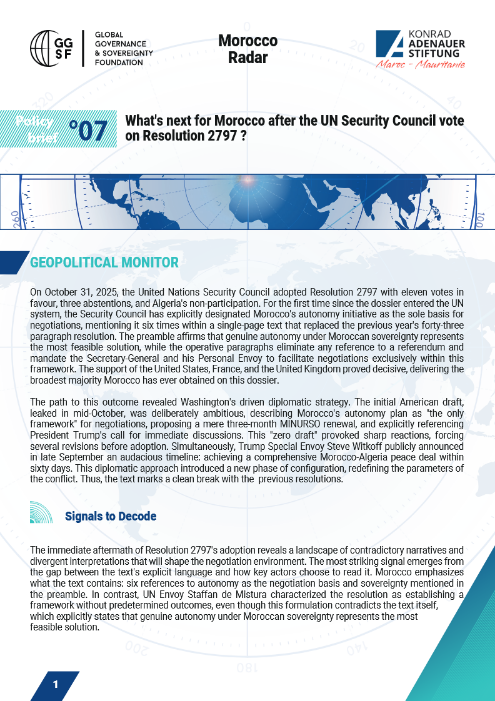
On October 31, 2025, the diplomatic landscape of the Maghreb was fundamentally reconfigured. With the adoption of Resolution 2797, the United Nations Security Council (UNSC) did not merely renew a mandate; it codified a new reality. For the first time in the history of the dossier, the Council explicitly designated Morocco’s autonomy initiative as the sole basis for negotiations, effectively burying the referendum option that has stalled progress for decades.
As detailed in GGSF Policy Brief No. 07, this resolution represents a decisive break with the past. The support of the United States, France, and the United Kingdom was instrumental in delivering this outcome. However, the diplomatic victory brings a new burden of responsibility: Morocco must now transition from advocating for its plan to defining the operational mechanics of “genuine autonomy.”
For policymakers and investors, the message is clear: the question is no longer who holds sovereignty, but how that sovereignty will be implemented.
Signals to Decode: The “Zero Draft” and the Vote
To understand the magnitude of this shift, one must look at the specific metrics and maneuvers that defined the October session.
- The Vote Count: The resolution passed with eleven votes in favor, three abstentions, and—crucially—Algeria’s non-participation.
- The Textual Shift: The final text mentions Morocco’s autonomy initiative six times within a single page, while eliminating the forty-three paragraphs of context found in previous years. It mandates the Secretary-General to facilitate negotiations exclusively within this framework.
- The American Push: The process was driven by an aggressive US diplomatic strategy. An initial “zero draft” leaked in mid-October proposed a mere three-month renewal and explicitly referenced President Trump’s call for immediate discussions.
- The Timeline: Trump Special Envoy Steve Witkoff publicly announced an audacious goal in late September: achieving a comprehensive peace deal within sixty days. While this timeline was ambitious, it signaled that the dossier has moved from a technical UN process to high-stakes American diplomacy.
Strategic Positioning: Defining “Genuine Autonomy”
Does Morocco have a role to play in this new phase? The answer is existential. The Kingdom must now transform political support into institutional reality.
King Mohammed VI’s announcement on October 31 that Morocco will “update and formulate the autonomy initiative in detail” is the strategic pivot point. The 2007 proposal, while visionary, lacks the granular detail required for implementation. Morocco’s challenge is to articulate a governance model that grants meaningful self-governance—covering financial arrangements, competency distribution, and democratic mechanisms—while maintaining total coherence with the national territorial organization.
By leveraging the 2011 Constitution and its advanced regionalization framework, Morocco aims to show that autonomy in the Southern Provinces is not an exception, but the fullest expression of the Kingdom’s decentralized governance model.
Opportunities & Risks
The resolution opens a path to a definitive settlement, but the road is mined with semantic and procedural traps.
Opportunities
- Legal Consolidation: With the Security Council endorsing autonomy under Moroccan sovereignty, international legal bodies (including the European Court of Justice) will face pressure to align their rulings with this framework. This opens the door to legal normalization regarding trade and resource exploitation.
- Economic Acceleration: The removal of political ambiguity serves as a green light for global capital. The region is poised to become the “economic lung” of Morocco’s Atlantic facade, driven by the Atlantic Port of Dakhla, renewable energy projects, and the Nigeria-Morocco Gas Pipeline.
- End of the Narrative: Resolution 2797 deprives adversaries of their “alternative narrative,” forcing the conflict resolution process entirely onto Morocco’s terms.
Points of Vigilance
- The “Genuine” Trap: The Security Council used the term “genuine autonomy” without defining it. This semantic ambiguity creates a risk: adversaries may argue that Morocco’s updated plan, no matter how generous, is not “genuine enough,” using this undefined standard to demand unacceptable concessions.
- Creeping Normalization: The risk exists that without rapid progress, the “final settlement within reach” dynamic could degrade into a new status quo of endless annual renewals.
- Displacement of the Basis: Algeria and the Polisario may attempt to displace discussions back to “confidence-building measures” or parallel tracks, effectively reintroducing discarded options through the back door.
Foresight: The High-Stakes American Diplomacy
Looking ahead, GGSF analysts identify the Trump administration’s involvement as the decisive variable. Steve Witkoff’s initiative has placed Algeria and the Polisario in a strategic bind.
What to Watch:
- The Strategic Review: The resolution mandates a strategic review within six months. This is the next critical stress test for the parties involved.
- The Algierian Dilemma: Refusing to engage with the American initiative carries direct consequences for Algeria’s bilateral relations with Washington, affecting security cooperation and economic partnerships.
- The Terrorist Designation Risk: The Polisario faces a shrinking window to maneuver, with the potential threat of a US terrorist designation looming if they obstruct the peace process.
While a deal by mid-December (the original Witkoff target) was unlikely, the pressure will not abate. Morocco holds the high ground because it can engage on substance, presenting its updated plan as the constructive answer to the world’s demand for a solution. The coming months will determine if the other parties isolate themselves or accept the new geopolitical reality.